Dogberry
Much Ado About NothingDogberry is the constable of Messina and the self-important leader of its Watch. He enters not as a polished representative of law but as a comic embodiment of local authority: his office gives him responsibility for surveillance, examination, and public order, while his language repeatedly strains against the very precision that those duties require. Yet the gap between his confused speech and his practical effectiveness is central to his significance. Dogberry’s Watch uncovers the truth that more elevated figures have failed to see, making him both a source of farce and the unlikely instrument of justice.
Identity and Introduction
Dogberry first appears in a street scene with Verges and the Watch, where the officers are being organized for their nightly duty. Verges instructs Dogberry to give the men their charge, establishing Dogberry as the superior figure within this modest civic hierarchy. Dogberry immediately turns the assignment into a display of rank and self-regard by asking who among the assembled men considers himself the least deserving person to be constable. The question reveals an authority obsessed with its own dignity: instead of beginning with practical instructions, he makes the Watch’s ceremony revolve around his office.
The scene also defines the social texture of Dogberry’s authority. He is not a prince, nobleman, or learned judge; he is a neighborhood officer whose power depends on routine, watchfulness, and the recognition granted by the community. His exchanges with Verges and the Watch place him among ordinary civic personnel, but his manner continually enlarges the importance of his position. The contrast between his humble institutional setting and his grand conception of himself produces the comic effect that will accompany his later contribution to the plot.
The Watch and Its Methods
Dogberry’s first responsibility is to direct the Watch, and his authority is expressed through orders, admonitions, and procedural language. The Watchmen are told to keep watch and remain attentive to anything of weight, while Dogberry presents himself as the person to whom serious matters must be referred. His parting instruction combines a demand for secrecy with a theatrical assertion of availability: the men are to keep their fellows’ counsels and their own, and to call him if anything important occurs. The wording is comic because it treats a small nocturnal patrol as if it were an elaborate state intelligence service, but the instruction also establishes the mechanism by which the conspiracy will be detected.
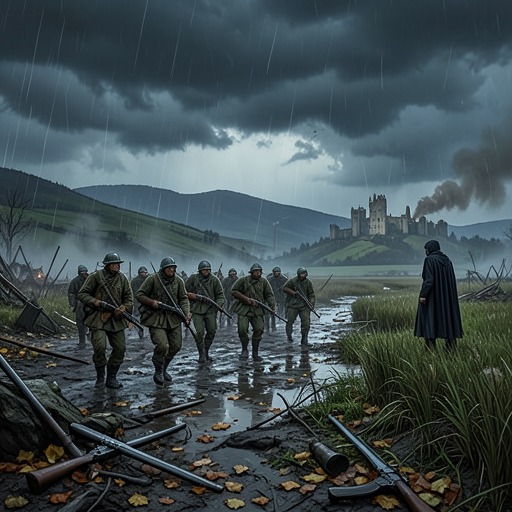
After Dogberry and Verges leave, the Watch settles on the church bench until two and then plans to go to bed. This detail exposes the distance between official vigilance and ordinary human fatigue. The Watch is charged with guarding the town, yet its immediate practical arrangement is to sit, wait, and sleep. Dogberry’s authority therefore operates through an imperfect apparatus: the men are not heroic investigators, and the constable’s commands are not delivered with judicial clarity. Nevertheless, the apparently inadequate system becomes the channel through which Borachio and Conrade are overheard.
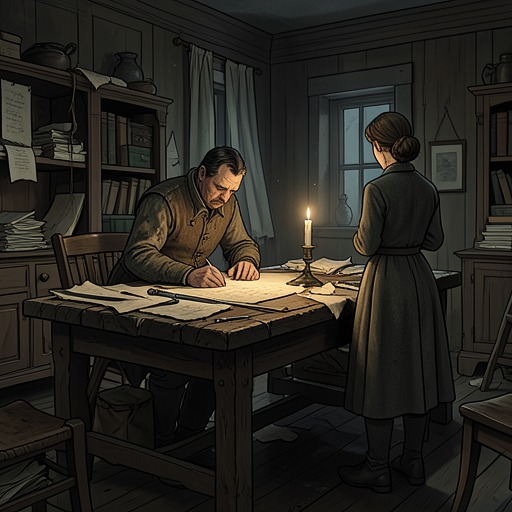
Dogberry’s comic verbal habits do not prevent him from recognizing that a matter has legal weight. When the Watch apprehends two suspicious persons, he brings the report to Leonato rather than silently keeping the discovery within his own circle. Leonato, in haste, orders Dogberry and Verges to examine the prisoners themselves and bring the examination to him. The command places Dogberry in a consequential position: a local officer who is normally treated as a comic subordinate is temporarily entrusted with the process of extracting and transmitting evidence.
Discovery of the Conspiracy
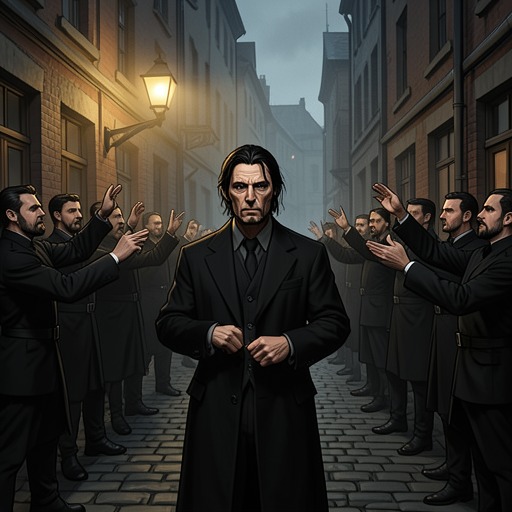
Dogberry’s greatest plot function is connected with the Watch’s capture of Borachio and Conrade. The prisoners are later brought into a prison scene with Dogberry, Verges, Sexton, and the Watch, an arrangement that gives the constable’s earlier patrol a concrete legal aftermath. His question about whether the whole assembly has appeared shows him trying to stage the examination as a formal proceeding. The gowns worn by Dogberry, Verges, and the Sexton further give the encounter an improvised ceremonial character: the civic officers dress for justice even while Dogberry’s speech continually unsettles the dignity of the occasion.
The information obtained from the prisoners is decisive because it exposes false report and slander against Hero. Dogberry’s account to Don Pedro identifies several forms of wrongdoing: the men have committed false report, spoken untruths, slandered, belied a lady, and verified unjust things. His list is malformed in its order, moving through contradictory numerical markers before arriving at the conclusion that they are lying knaves. The disordered enumeration is a signature of Dogberry’s speech, but its substance is unmistakable. The accusation names the conspiracy’s central acts and converts a rumor-producing deception into an offense that can be publicly examined.
This is the reversal that makes Dogberry more than a comic accessory. The powerful characters have been drawn into the consequences of the slander, while the Watch, operating at the margins of aristocratic life, has captured the people responsible for manufacturing it. Dogberry does not solve the deception through elegant deduction or psychological insight. He enables the solution through observation, apprehension, and compulsory examination. His achievement is therefore procedural rather than intellectual: the truth reaches the court because the Watch noticed what it heard and Dogberry insisted that the discovery be processed as evidence.
Language, Authority, and Comic Misrule
Dogberry’s speech repeatedly exposes the instability of official language. Legal categories appear in his account, but they arrive in distorted sequence; the vocabulary of judgment is present, yet the syntax and numbering make the speaker seem unable to control the structure of his own indictment. This mismatch creates a distinctive form of dramatic irony. The audience can understand the criminal facts even when Dogberry cannot present them with professional coherence, so the failures of expression do not erase the force of the evidence.
His authority is similarly double. On one level, Dogberry performs the dignity of office through titles, commands, ceremony, and an insistence that others acknowledge his standing. On another, his verbal confusion exposes how much institutional power depends on performance. The gowns, the examination, the charge to the Watch, and the language of offenses all imitate the outward forms of legal order. Dogberry’s comic mismanagement makes those forms visible as forms, yet the procedures still produce a real result. Authority appears ridiculous without becoming entirely ineffective.
Dogberry also stands in sharp contrast with the lovers and nobles whose language dominates the surrounding action. Beatrice and Benedick use wit as competitive social weaponry, while the higher-ranking characters debate honor, judgment, and accusation. Dogberry’s language belongs to a different register: it is inflated, repetitive, and misaligned, but it is attached to the concrete work of patrol and arrest. The contrast prevents wit from being treated as the only valuable form of intelligence. In Dogberry’s world, listening and reporting matter more than verbal elegance, even though the report is comically damaged in transmission.
Narrative Role and Consequence
Dogberry’s narrative importance lies in the way he links the town’s everyday routines to the restoration of public truth. His Watch begins with a seemingly ordinary night duty, complete with an expectation of sitting on a church bench and eventually going to bed. That routine becomes the setting for the discovery of a conspiracy whose effects reach the honor, marriage, and reputation of the principal characters. The movement from idle watchfulness to criminal apprehension gives the subplot its characteristic reversal: what appears least grand becomes the means by which the grand deception is undone.
His later confrontation with Borachio and Conrade brings the comic officer into direct contact with the men whose actions have damaged Hero. Dogberry tells Don Pedro that justice must deal with them and identifies their offenses in a confused but comprehensive catalogue. The scene thus converts Dogberry’s earlier self-display into public utility. He may not command the vocabulary of justice, but he delivers its perpetrators to those who can act upon the facts.
Dogberry’s ending significance is consequently paradoxical. He remains comic because his sense of rank exceeds his verbal competence, and because the forms of law are filtered through his malapropistic performance. But he is also indispensable. Without the Watch’s apprehension and Dogberry’s insistence on examination, the false report might remain powerful enough to define Hero. The constable’s contribution shows that truth in Messina is not restored solely by noble insight or romantic reconciliation; it also depends on the persistence of minor officials whose imperfect speech nevertheless preserves the chain from observation to accusation to exposure.